Southern Utah Travel FAQs: National Parks, Itineraries & Planning Tips
Planning a trip to Southern Utah? Get answers to the most common questions about timing, itineraries, national parks, permits, fees, hiking, driving, and everything else you need to know before you go.


If you’re planning your first trip to Southern Utah, chances are you have a lot of questions — especially around building a Southern Utah itinerary and choosing the best time to visit Southern Utah. Most of those answers aren’t clearly laid out in one place. These FAQs cover everything from timing and permits to how many days you actually need, so you can plan your Utah national parks road trip with confidence and avoid the mistakes I see all the time. If you’re feeling overwhelmed or not sure where to start, you’re in the right place.
Please reach out to mallory@roamingthesouthwest.com if you cannot find an answer to your question.
How many days do I need to visit Southern Utah?
You need at least 5–7 days to visit multiple parks without rushing. If you want to see all five Utah national parks, plan closer to 7–10 days. You will quickly learn you will want to come back for future vacations. Don't Miss Southern Utah Travel Guide for First-Time Visitors
Can I visit all 5 Utah national parks in one trip?
Yes—but not in just a few days. A realistic trip is 7–10 days if you want to actually experience each park instead of just stopping for photos. Less than 7 days will result in more driving than exploring. Read Best Route for Visiting Utah National Parks in One Trip
What order should I visit Utah's national parks?
The most efficient order depends on where you're flying in and out. If you're traveling from Las Vegas to Salt Lake City, I recommend Zion → Bryce Canyon → Capitol Reef → Canyonlands → Arches. If you're starting in Salt Lake City and ending in Las Vegas, simply reverse the route. This minimizes backtracking and gives you a natural progression through all five Utah national parks.
Read Best Route for Visiting Utah National Parks in One Trip for route options, driving times, and where to stop along the way.
How many days should I spend at each Utah national park?
For a first trip, I recommend at least 2 days in Zion, 1 day in Bryce Canyon, 1–2 days in Capitol Reef, and 2–3 days around Moab for Arches and Canyonlands. If you're planning longer hikes or want time outside the national parks, add extra days wherever you can.
You can technically visit all five parks faster, but you'll spend a lot more of your trip driving instead of actually exploring.
What is the best 7-day Utah national parks itinerary?
If you only have one week, the most efficient route is typically a one way route between Las Vegas and Salt Lake City, connecting Zion, Bryce Canyon, Capitol Reef, Canyonlands, and Arches without backtracking.Read 7 Day Utah National Parks Itinerary (Las Vegas → Salt Lake City)
What is the best airport for visiting Southern Utah?
Las Vegas (LAS): best for Zion & Bryce and usually overall cheapest, but can be hard to loop if you only have 7 days and want to see all 5 of Utah's National Parks
Salt Lake City (SLC): best for Moab, Hanksville, and Capitol Reef OR if you can get a better deal than Vegas
Phoenix (PHX): good for adding Northern Arizona, like Sedona, Flagstaff, and the Grand Canyon
Do I need a rental car to visit Southern Utah?
Yes, I highly recommend having a rental car for a Southern Utah road trip. The national parks are spread across a large area, and there isn't practical public transportation connecting Zion, Bryce Canyon, Capitol Reef, Canyonlands, and Arches.
You don't need a 4WD vehicle for a typical Utah national parks road trip. The main highways and park roads are paved, and a standard 2WD rental car is sufficient for most visitors.
How far apart are Utah's national parks?
Utah's national parks are much farther apart than they look on a map. Zion and Bryce Canyon are relatively close, but the distances increase as you travel toward Capitol Reef and Moab. Driving between all five parks requires several hours on the road throughout your trip, which is why I recommend at least 7–10 days if you want to visit all five.
Don't forget to account for stops along the way. Some of the drives between Utah's national parks are destinations themselves, and rushing from park to park means missing a huge part of Southern Utah.
Do any Utah national parks require reservations in 2026?
Utah national parks do not require general entry reservations in 2026. Parks like Zion, Bryce Canyon, Capitol Reef, and Canyonlands allow entry with a standard park pass or entrance fee. Read Do You Need Reservations for Utah National Parks?
However, that doesn’t mean you can show up without planning. Some parks still use shuttles, capacity limits, and permit systems for specific hikes and experiences. For example, Zion requires a shuttle part of the year, and hikes like Angels Landing require permits.The biggest mistake is assuming “no reservations” means no planning. In reality, timing, permits, and logistics still matter just as much for your overall experience.
Which hikes in Southern Utah require permits?
Several popular hikes require permits, including Angels Landing, The Subway, Fiery Furnace, The Wave, Coyote Buttes South, and Kanarra Falls.For more information on which hikes require a permit, read Southern Utah Hikes Requiring Permits (Full List + How to Apply)
Is Southern Utah too hot to visit in summer?
Southern Utah can be extremely hot in summer, especially during June, July, and August. Daytime temperatures regularly reach 100°F or higher at lower elevations, including areas around Zion, Moab, Arches, and Canyonlands.
You can still visit Southern Utah in summer, but you'll need to plan around the heat. Start hikes around sunrise, avoid strenuous activity during the hottest part of the afternoon, carry plenty of water and electrolytes, and don't underestimate how quickly you can become dehydrated in the desert.
Higher-elevation destinations like Bryce Canyon are typically much cooler, so temperatures can vary significantly depending on where you're visiting.
If you're planning a summer Utah national parks road trip, I recommend scheduling hikes and outdoor activities early in the morning and using the hottest part of the day for scenic drives, overlooks, meals, or traveling between destinations.
For more on staying hydrated in the desert, read How Much Water Do You Need to Drink Hiking in Southern Utah?
What is the best time to visit Southern Utah?
There is no perfect month. Spring and fall are ideal (March, April, September, October). Summer is HOT so would avoid June, July, August, winter has fewer crowds but shorter days. Read Best Time to Visit Southern Utah (Month-by-Month Guide) and When NOT to Visit Southern Utah (Brutal Truth From A Local)
Can you visit Southern Utah in winter?
Yes! Southern Utah is open year-round, and winter can be one of the best times to visit if you want fewer crowds. However, conditions vary dramatically depending on elevation. Lower elevations around Zion and Moab can be relatively mild, while Bryce Canyon sits above 8,000 feet and regularly receives snow.
Winter also means shorter daylight hours, cold mornings, and the possibility of snow or ice on trails and roads. Always check current park and road conditions before heading out.
When is monsoon season in Southern Utah?
Monsoon season typically occurs during the summer, with thunderstorms and flash flooding becoming a major concern in July, August, and into September. Storms can develop quickly, and rain falling miles away can cause dangerous flash flooding in slot canyons.
Never enter a slot canyon when storms or flash flooding are possible. Check the weather forecast and flash flood potential before heading into areas like The Narrows or other slot canyons, even if the sky above you looks clear.
What is the best time of day to visit Utah national parks?
Arrive before 8am or after 4pm for the best experience in peak season and summer to avoid crowds and heat. Winter entrance time doesn't matter as much, as crowds are much lower.
When are Utah national parks the most crowded?
Peak crowds hit during spring break and fall break. This lines up when our temperatures are most desirable.
When are Utah national parks the least crowded?
Winter generally brings the fewest crowds to Utah's national parks, especially from December through February. Late fall and early spring can also be quieter than peak spring and fall travel periods.
If you're visiting during a busy month, weekdays, early mornings, and later afternoons are usually your best bet for avoiding the largest crowds.
Are gas stations easy to find in Southern Utah?
Gas stations can be far apart—plan ahead. Know ahead of time and always pay attention to stops. You may drive LONG distances without seeing a gas station so when you're in the gateway towns surrounding the parks, fill up your tank.
Should I use maps offline in Utah national parks?
Yes, and it is encouraged. Download maps ahead of time for navigation without service. You will not have cell service along many of the driving routes in remote Utah. As far as hiking, I encourage you to download trails either via Gaia or AllTrails for offline trail maps.
Do I need 4WD or high clearance for driving in Southern Utah?
Main roads connecting all of Utah's National Parks are accessible and paved, but some areas off the beaten path require high clearance. Some areas that require high clearance - Cathedral Valley, Valley of the Gods, Monument Valley Scenic Drive, Mars Desert Research Station, Shafer Trail, White Rim Road, and that list isn't nearly exhaustive.
**For MOST road trips visiting only the national and state parks, any 2wd vehicle should be sufficient, weather permitting.**
Are the roads in Southern Utah safe to drive?
The main highways and roads connecting Utah's national parks are paved and easy to drive in normal conditions. Remote roads are a different story. Dirt and backcountry roads can become impassable very quickly after rain or snow, even with 4WD.
Never assume a road is safe because it's marked on Google Maps. Check current road and weather conditions before driving into remote areas, and don't attempt muddy backcountry roads just because you have a high-clearance or 4WD vehicle.
Will I have cell service in Southern Utah?
Most all towns will have service, however service is limited between parks. You will find you have service in the gateway towns near the parks, however will likely not have service within the national parks and along many of the drives in between.
What should I pack for a Southern Utah road trip?
What you need depends heavily on the season, but I always recommend carrying more water than you think you'll need, sun protection, layers, sturdy shoes, snacks, a basic first-aid kit, and downloaded offline maps.
Temperatures can change dramatically between parks and elevations, so don't pack based on the forecast for just one destination. Southern Utah can be hot and sunny in one location while it's cold or even snowing at higher elevations.
Do I need to pay entrance fees at every national park?
Yes, unless you have the annual pass. Read Utah National Park Entrance Fees (Costs & Fees For Each Park) for a total breakdown.
Is the America the Beautiful Pass worth it?
If you're a resident, it pays for itself after visiting 3 parks. Read Is the America the Beautiful Pass Worth It?
How much does it cost to visit Utah national parks?
Fees range from $20–$35 per park and can see a full break down. Read Utah National Park Entrance Fees (Costs & Fees For Each Park)
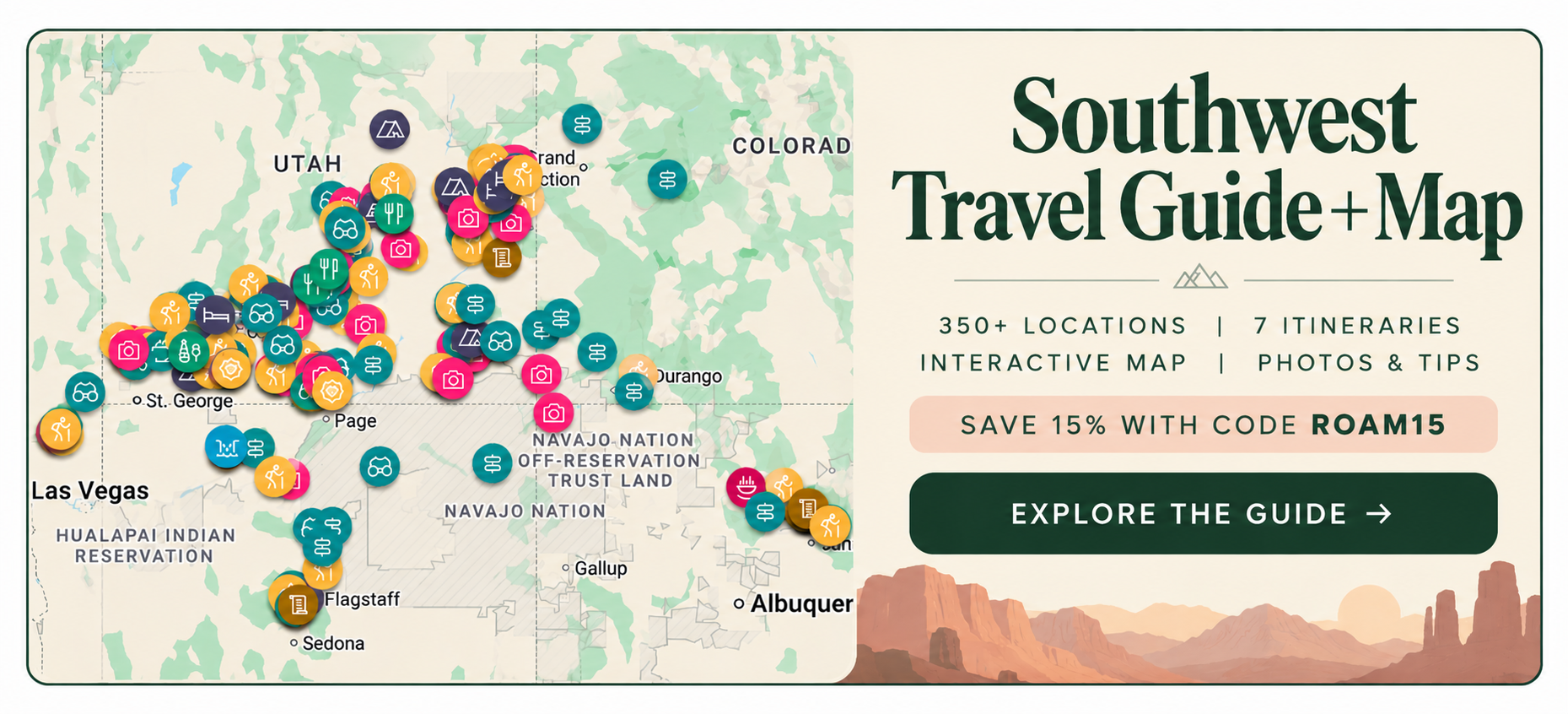
What is included in your Southwest Adventure Guide?
This digital guide includes 350+ personally vetted locations across the Southwest, including hikes, scenic drives, overlooks, and hidden gems. It also includes 7 pre-built itineraries, exact trailheads, and map pins so you can plan your trip without starting from scratch.
Code = ROAM15 always saves on my Southwest Adventure Guide
Can your Southwest travel guide be used offline?
Yes. My guide is fully downloadable through the Rexby app, so you can access maps, locations, and itineraries even without cell service—something that’s essential in Southern Utah.
Do you offer custom Utah itineraries?
Yes. I offer custom itineraries tailored to your trip, based on your travel dates, priorities, and pace. I build these myself personally and these are designed to help you maximize your time without overpacking your schedule. Book your own customized itinerary.
What’s the difference between your guide and a custom itinerary?
The digital guide is a self-paced planning tool with locations and itineraries you can customize yourself. A custom itinerary is fully tailored to your trip, where I map out your route, timing, and priorities for you.
Do I receive a physical book or PDF of the guide?
All of my guides are digital, interactive travel guides that you access through the Rexby app or website.Instead of a static PDF, you get:
- A fully searchable guide (by location, activity, or map)
- Clickable maps + exact trailheads
- The ability to filter and plan your trip in real time
- Lifetime updates (no re-downloading new versions)
You can also download the guide for offline use, so you’ll still have access when you’re out of service out exploring in the Southwest.
Bottom line:
No physical book or PDF is mailed or emailed—but you’re getting something far more functional for actually planning and navigating your trip.
Final Thoughts
I hope these answers make planning your trip feel simpler and more doable. Southern Utah can feel overwhelming at first, but once you understand the timing, logistics, and a few key rules of the road, it becomes one of the most rewarding places to explore. If you still have questions, feel free to send them to mallory@roamingthesouthwest.com after looking over the website.
Planning to Visit Southern Utah?
I’ve spent 10+ years exploring the Southwest, and my digital guide is everything I’d actually recommend. It's organized so you can build your trip without second-guessing every stop. It has hikes, scenic drives, overlooks, and 7 pre-built itineraries so you can plan it right the first time. Click the map above to learn more.